Track every motorcycle from the moment it enters the workshop through delivery
ServiceChain organizes intake, evidence, diagnosis, approvals, repairs, payments, and delivery in one digital service record for motorcycle workshops.
Motorcycle service record
Honda CB190R
Demo customer · Demo reference
Intermittent power loss. Awaiting inspection and mechanic diagnosis.
Main service stages
- 1Intake
- 2Diagnosis
- 3Approval
- 4Repair
- 5Ready
Service log
Intake recorded; diagnosis pending.
Customer view
Shareable tracking through a service-record link.
Video introduction
Meet ServiceChain in under a minute
See how the platform organizes motorcycle intake, service records, estimates, and tracking. This video is a commercial introduction; below it you will find anonymized product-interface screenshots and aggregated operational evidence.
No autoplay. The YouTube player is requested only after you press the video button.
Meet ServiceChain in 36 seconds
A short introduction to how ServiceChain organizes workshop services.
Watch directly on YouTubePlayback on YouTube is subject to its own privacy terms.
As a workshop grows, memory is no longer enough
Information gets scattered across notebooks, messages, loose photos, repeated calls, and different people's memories.
“Who checked in this motorcycle?”
“What issue did the customer report?”
“Has it been inspected?”
“Has the customer approved the estimate?”
“Which part is still needed?”
“Who is working on it?”
“Why is it still on hold?”
“What was replaced last time?”
Disconnected information undermines trust
Without a visible, shared digital record, parts orders can be wrong, work can be delayed, and warranty discussions can become subjective. When customers cannot see the process, they may question the work performed.
One motorcycle. One service record. The whole job.
ServiceChain brings technical, operational, and tracking information into one service record. Each participant sees the views enabled for their role.
A shared source of truthCaptured data is gathered in a service record shared with authorized users.
Linked to the VINEach record is linked to the motorcycle service file to maintain a searchable service history.
Contact details and preferences
VIN, make, model, year, license plate
Reported symptoms and faults
Intake photos
Readings and technical checks
Recorded notes and technical diagnosis
Parts and labor costs
Recorded approval status
Required and installed parts
Workflow change log
Payment record, when applicable
Closure and delivery record
Accumulated record for future reference
Operational workflow
Five visible stages, one record per service
From intake through delivery, ServiceChain helps document owners, progress, and evidence. Available actions depend on each service record's status.
- 01 / 05
Intake
The customer, motorcycle, reason for intake, and initial photos are recorded.
- 02 / 05
Diagnosis
The inspection, technical findings, and proposed service are documented.
- 03 / 05
Approval
The estimate is prepared and its approval status is recorded.
- 04 / 05
Repair
The workshop documents the work and updates the service record.
- 05 / 05
Ready for delivery
The service closure, payment, and delivery are recorded as applicable.
Inspections, photos, and technical notes are activities within the service record, not additional invented stages.
Product interface
ServiceChain on a phone
These are screenshots of the application's mobile interface. They were cropped and anonymized before publication; synthetic examples elsewhere on this page are not screenshots of real data.
These screenshots show the current ServiceChain app interface in Spanish.
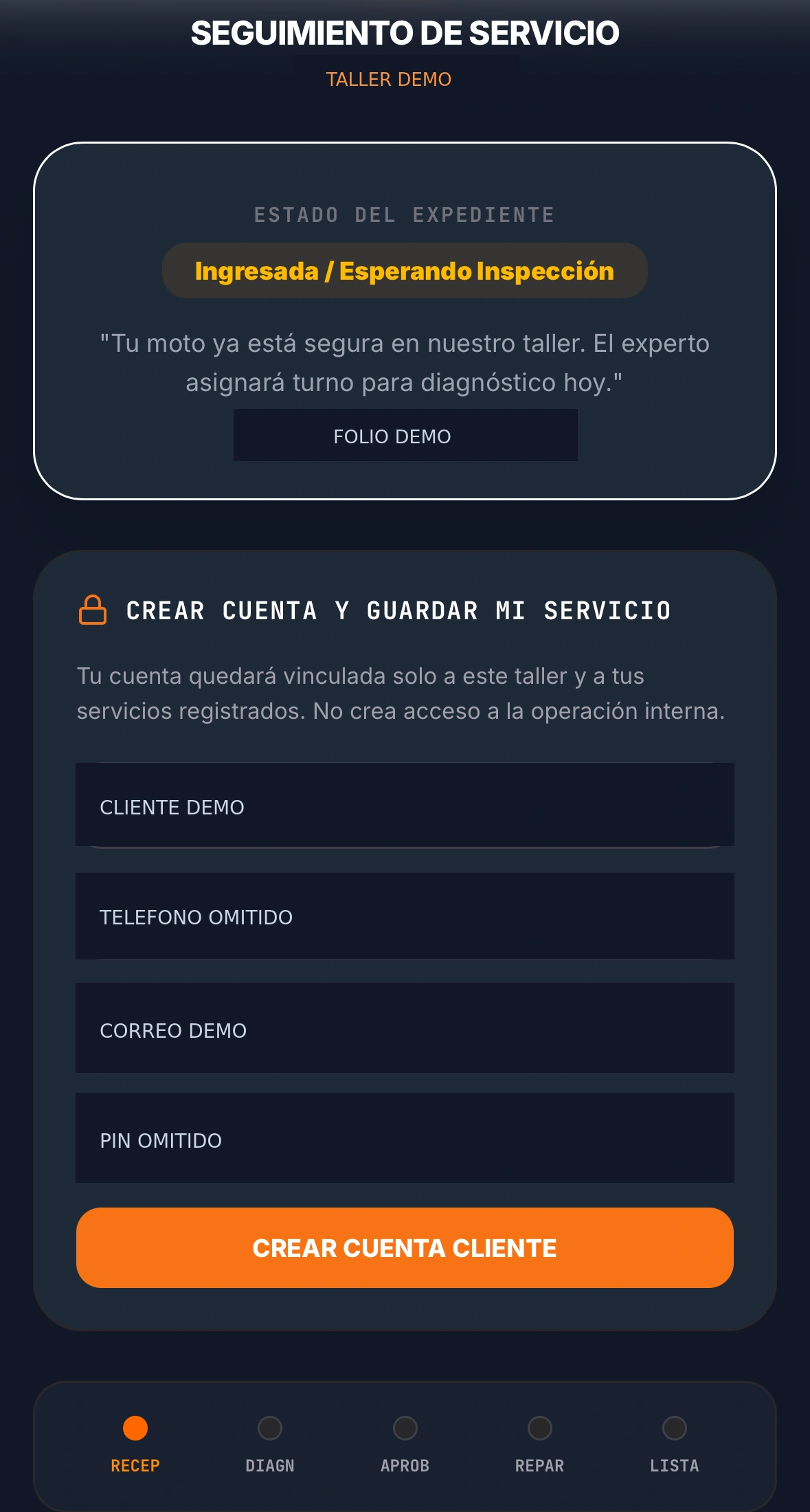
Customer portal
Mobile service tracking with workshop, reference, and account details covered by opaque masks; visible labels are demonstrative.
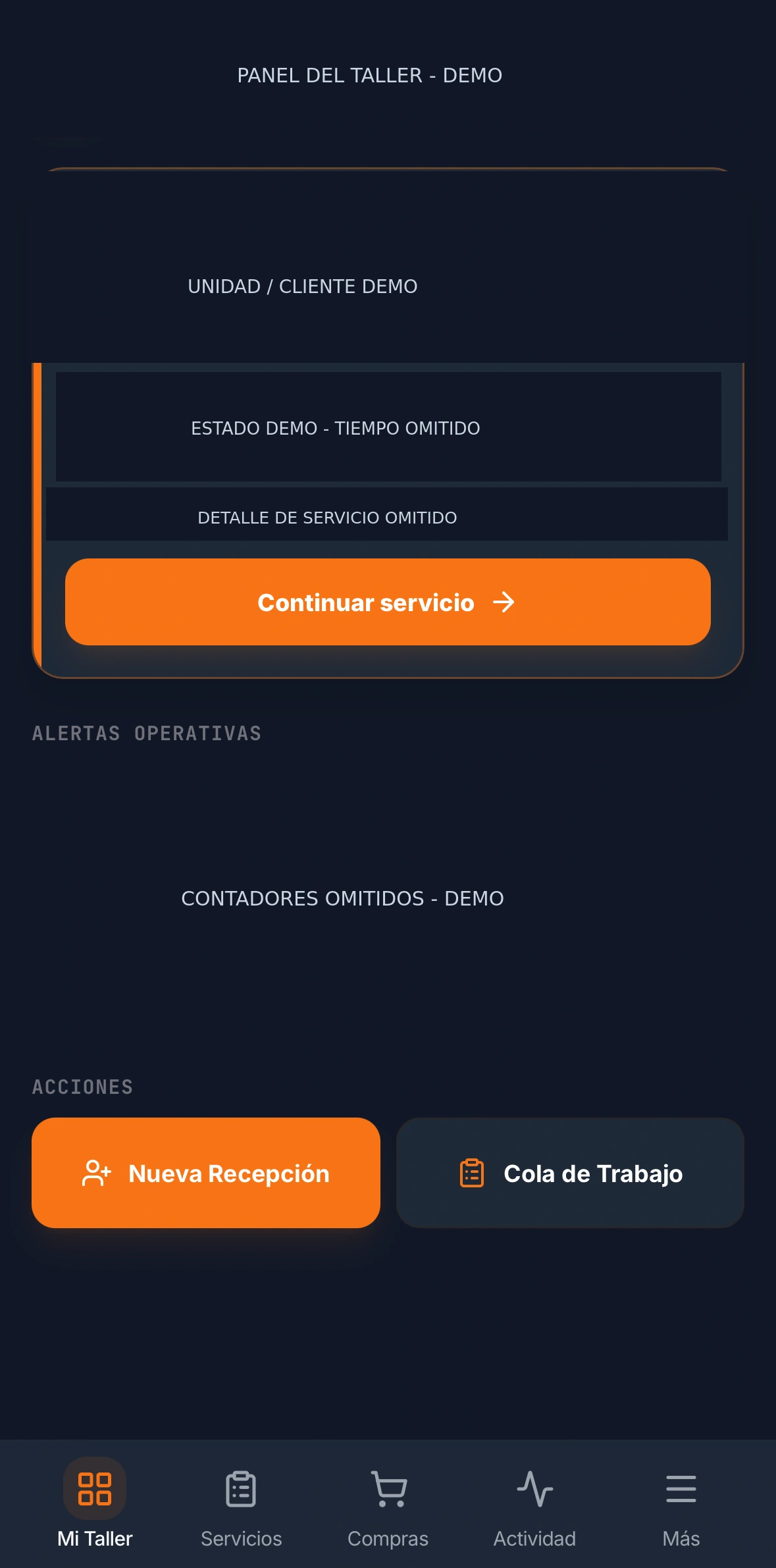
Workshop dashboard
Mobile operations view with identity, service record, timings, and counters replaced by opaque demo blocks.
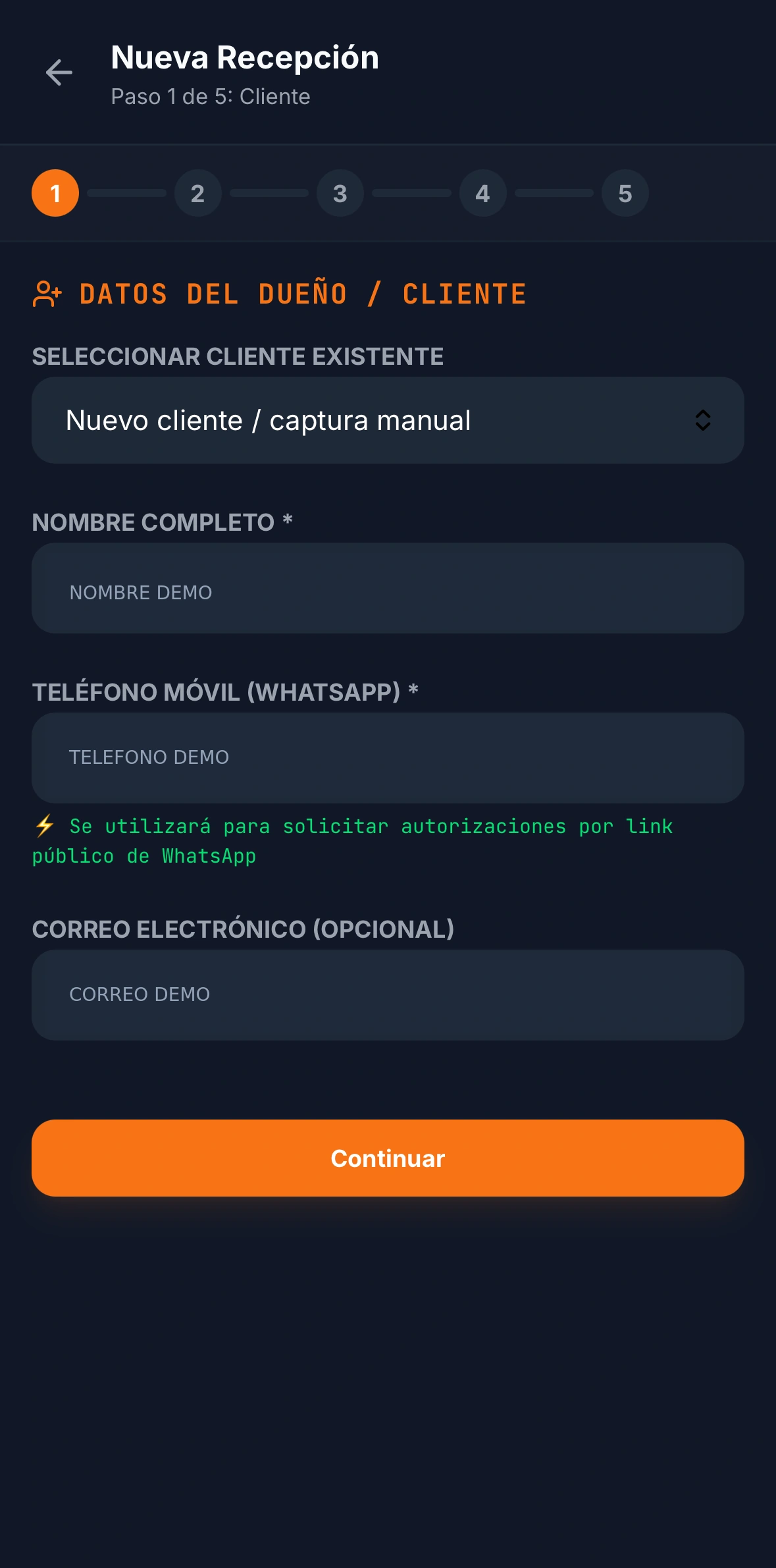
New intake
Empty intake form; the device status bar is cropped, and sample name, phone, and email values are replaced with demo labels.
Visual evidence of the interface, not of results or live operations. Outcomes depend on each workshop's implementation.
Each person sees what they need to do their work
ServiceChain organizes workshop tasks into straightforward interfaces tailored to the needs of each operational role.
Owner or administrator
Oversees workshop operations without relying on constant calls.
Key responsibilities:
Checks the current status of every motorcycle in service.
Monitors mechanic productivity without interrupting their workflow.
Reviews workshop activity, service times, and associated costs.
Retains control of the price catalog and final estimates.
Oversees workshop operations without relying on constant calls.
Responsibilities:
Checks the current status of every motorcycle in service.
Monitors mechanic productivity without interrupting their workflow.
Reviews workshop activity, service times, and associated costs.
Retains control of the price catalog and final estimates.
Tools for managing the complete service workflow
Tools designed to organize the technical, operational, and customer workflows of a motorcycle workshop.
Service record and intake
- Customer and motorcycle records.
- Reference numbers for service orders.
- Record of reported issue and mileage.
- Photos linked to the service record.
- Lookup of active and closed services.
Diagnosis and tracking
- Record of symptoms, inspections, and technical notes.
- Track each service order's status.
- Activity and operational change log.
- Lookup of documented history.
Estimates and customer service
- Estimates linked to each service.
- Lookup of an order's approval status.
- Link or QR code for customer service tracking.
- Service closure and delivery record.
Designed around how a motorcycle workshop operates
Compare an informal workflow with the traceability and digital organization provided by ServiceChain.
| Typical workflow (paper or chat) | With ServiceChain |
|---|---|
Notebook records can be lost or incomplete. | A centralized digital service record for authorized team members. |
Messages and photos scattered across personal WhatsApp conversations. | History and evidence linked directly to the service order. |
Verbal approvals that are difficult to verify if a dispute arises. | Approval status recorded against the service order. |
No physical evidence of the motorcycle's condition at intake. | Intake photos and documentation linked to the service record. |
Complete dependence on memory or the owner's presence. | Service statuses and an operational log available to the workshop. |
Repeated customer calls asking for updates. | Structured tracking the customer can view through a web portal. |
No service history when the assigned mechanic changes. | Lookup of service orders and activities recorded for the motorcycle. |
Notebook records can be lost or incomplete.
A centralized digital service record for authorized team members.
Messages and photos scattered across personal WhatsApp conversations.
History and evidence linked directly to the service order.
Verbal approvals that are difficult to verify if a dispute arises.
Approval status recorded against the service order.
No physical evidence of the motorcycle's condition at intake.
Intake photos and documentation linked to the service record.
Complete dependence on memory or the owner's presence.
Service statuses and an operational log available to the workshop.
Repeated customer calls asking for updates.
Structured tracking the customer can view through a web portal.
No service history when the assigned mechanic changes.
Lookup of service orders and activities recorded for the motorcycle.
Already used alongside real workshop services
Aggregated, anonymized data from one founding workshop during June 2026. These figures are descriptive, not a performance promise.
Founding-workshop indicators
Founding-workshop orders during the period
Records for unique vehicles
Documented technical assessments
Services that reached a closed status
Technical and workflow metrics
33 of 36 orders with a recorded diagnosis
33 of 36 orders with a recorded estimate
Operational updates recorded in the log
Individual actions recorded in the workflow
Service time measured for completed jobs
Methodological note
Data from one founding workshop during June 2026. It describes one specific operation and does not guarantee the same results at other workshops. Service times depend on fault complexity, parts availability, and how quickly customers approve estimates.
How a service is documented in ServiceChain
Synthetic example of how service-order data can be organized. This is not a real record.
Demo motorcycle // Demo customer
REFERENCE: DEMO-027
RECORD: ILLUSTRATIVE DATE
Illustrative example: This is a simulation based on the platform's standard workflow, intended to illustrate its scope and visual structure.
“Intermittent power loss at higher speeds. The engine feels restricted.”
Fuel system inspection required. The fuel pre-filter is obstructed and the spark plug shows carbon buildup.
Example of a recorded approval
Synthetic reference DEMO-027
Service-record status
Checked in / Awaiting inspection
The motorcycle has been received. The next step is the initial inspection.
SC-DEMO-027
- Intake
- Diagnosis
- Approval
- Repair
- Ready
Vehicle details
Demo motorcycle
Customer: Demo customer
Illustrative recreation with synthetic data; not a real session or active public link.
Customer tracking portal
Customers can check their motorcycle's status on a phone
The workshop can share a link or QR code for a service record. Customers can view available tracking information without accessing the workshop's internal dashboard.
Portal access and approval workflows must be validated for each workshop during setup and acceptance testing.
Gradual adoption without stopping the workshop
ServiceChain implementation adapts to your business's actual pace, supporting a gradual transition that can be adjusted with the team.
Operational assessment
We assess your workshop's current needs and bottlenecks.
Role configuration
We define access for mechanics, reception, and assistants.
Workflow adaptation
We adjust inspection checklists to the types of motorcycles you service.
Brief training
We hold an interactive online session so your team can learn the platform.
Start with selected services
We choose a suitable number of orders to validate the workflow in real conditions.
Guidance
We review support needs during the workshop evaluation.
Results review
We review initial operational metrics and customer response.
Gradual expansion
We assess when to add more services based on results and agreed conditions.
Controlled, gradual change
ServiceChain does not require changing the whole operation overnight. We recognize that better organization is built gradually and must respect the hands-on work of your mechanics.
Founding workshops
Explore a gradual ServiceChain onboarding
If your workshop wants to organize its service records, we can review a demonstration and the feasibility of a controlled trial together. The format depends on the workshop profile and a later proposal.
Availability and terms are defined after reviewing the workshop's needs. You can submit an inquiry without scheduling a call.
Possible evaluation steps
- Step 1. Understand service volume, service types, and the current workflow.
- Step 2. Review a demonstration with fictional data and the available functions.
- Step 3. Decide whether controlled onboarding makes sense and how to measure it.
- Step 4. Agree in writing on scope, support, timing, and commercial terms.
ServiceChain is not necessary for every workshop
We want you to make an informed decision. Review the situations in which the platform may provide the most operational value.
It may be a good fit when:
- Several motorcycles are being repaired at the same time.
- Several people participate in each service (reception, mechanics, assistants).
- The owner or administrator cannot be present all the time to supervise.
- Estimate approvals or visual records of faults are getting lost.
- Customers repeatedly call to ask about motorcycle status.
- A structured service history is needed for each motorcycle.
- There is a genuine need to measure cycle time and workshop efficiency.
It may not be necessary when:
- One person services one motorcycle at a time and directly controls the entire process.
- Services are always immediate maintenance performed while the customer is present.
- The team lacks the time or technical readiness to record information.
- The workshop's only current administrative need is CFDI tax invoicing.
- The workshop must already follow a mandatory brand-owned corporate system.
Frequently asked questions
What to know about the platform, implementation, and system requirements.
It is a web platform for recording and tracking motorcycle workshop service orders, from intake through closure and delivery.
Yes. Mobile interfaces are available for workshop operations and customer tracking. The final experience is checked during the demonstration and setup.
A service record can contain vehicle information, reported issue, photos, diagnosis, estimate, status changes, and activities recorded by the workshop.
The workshop can share a link or QR code to a public tracking view of the service record. Available detail depends on the service and its configuration.
The product supports estimates and approval stages. Remote-approval behavior is verified for each workshop during onboarding tests; it does not replace legal or commercial agreements.
These capabilities are not presented here as guaranteed features. Their availability and terms must be confirmed through a technical review and a specific demonstration.
Configuration, guidance, timing, and any commercial proposal are defined after understanding each workshop's needs. This page does not advertise a price or guaranteed timeline.
Complete the Assess my workshop form or email servicechain@majestic-tech.com. We will review your inquiry and suggest a next step; an initial call is not required.
Tell us how your workshop operates
We will use this information to understand your operation, review your current workflow, and suggest an appropriate next step.